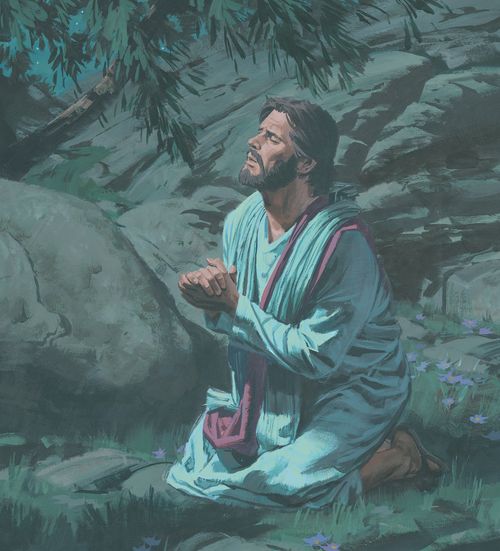
Jesus Suffers in the Garden of Gethsemane by Paul Mann
- The Challenge of Obedience
- Christ’s Suffering
- Plea for Relief
- Christ’s Reasons for Submission
- Fulfillment of God’s Will
- Executing God’s Will in Our Lives
- More of the Easter Series
- Want to Read More On Seeking Christ?
One of the most staggering and defining moments of Christ’s suffering and Atonement was when He chose to be obedient and submit to the will of God even though He desperately wanted relief from the weight of our salvation. Jesus had been chosen as the One to save us, and He was the only One who could.
In that moment, if Christ had refused the load put upon Him, if our Father had relented and taken away Christ’s suffering, not one of us would have any hope for salvation today.
Christ’s choice to submit His will to the will of our Father was the moment that all of us were truly saved. After He made that choice, nothing could stop Him from fulfilling God’s will – not men, not trials, not nails. Jesus knew the pain that was before Him, and He claimed all of it for our sake and God’s plan.
The Challenge of Obedience
All of us face the challenge of obedience. Every day, God asks us to be obedient to His commandments and gospel, and every day, because we are fallen people, we fall short of perfect obedience.
This isn’t a condemnation on us; it’s a simple reality.
Our fallen natures don’t give us an excuse to be disobedient, but we can understand ourselves and each other better when we recognize that we are not already perfect – we are in the process of becoming perfect. No, we don’t always follow the will of God, but we work toward being a little more obedient and submissive each day.
Understanding our struggle with obedience only puts Christ’s absolute obedience and submission in greater relief. What we must remember is that Jesus wasn’t forced to be obedient. He had the choice to obey or not to obey, just like we do. That’s what makes His obedience and submission to God’s will so powerful in our lives. Jesus chose to suffer and die for us. He overcame the challenge of obedience and submitted all He had to our Father in Heaven.
Each of us knows how difficult obedience can be. Knowing that, how much more can we appreciate Christ’s perfect obedience, especially in the face of the overwhelming task of claiming our salvation?
Christ’s Suffering
Christ’s choice to fulfill the will of our Father in Heaven was not an easy one. In making this choice, Christ had to embrace the worst suffering anyone has ever gone through.
He took the price of our sins upon Himself; the oppression of that cost brought so much stress to His body that He bled from every pore: “And being in an agony he prayed more earnestly: and his sweat was as it were great drops of blood falling down to the ground” (Luke 22:44).
Jesus faced betrayal, unjust imprisonment, false accusers, scourging, a crown of thorns, and mockery. He was given a death penalty without ever committing a crime. Soldiers hammered nails through His hands, wrists, and feet, pinning Him to a cross. He likely hung on the cross for hours, the weight of his body putting pressure on the nails. When thirst became enough for Him to ask for a drink, He was given vinegar instead of water.
Finally, Jesus gave up His life, sacrificing Himself for each and every one of us. After all of that, even after dying, His body was pierced in His side, to ensure that He really had died.
In Doctrine and Covenants 19, Jesus revealed a small insight into His experience:
17 But if they would not repent they must suffer even as I;
18 Which suffering caused myself, even God, the greatest of all, to tremble because of pain, and to bleed at every pore, and to suffer both body and spirit—and would that I might not drink the bitter cup, and shrink –
Jesus Christ, the Son of God, faced suffering so great that He struggled to complete the task God had given Him. But the suffering didn’t win out. Jesus still made the choice to see it through and submit to God’s will.
Plea for Relief
Though Christ did submit to God’s will and finish the task He had been given to save us all, Jesus still struggled to follow through. While He was in the Garden of Gethsemane, the pain and suffering for our sins overwhelmed Him, and He pleaded with our Father:
41 And he… kneeled down, and prayed,
42 Saying, Father, if thou be willing, remove this cup from me: nevertheless not my will, but thine, be done.
Jesus literally asked for the pain to be taken away from Him, for God to find some other way to save us. But it isn’t the plea for relief that makes this moment so incredible. It’s what Jesus immediately followed the plea up with.
“Nevertheless, not my will, but thine, be done” (Luke 22:42).
Even though He was suffering, even though He begged God to find another way, Jesus still used that same moment to submit Himself to God’s will. He knew that He was tasked with our salvation. He knew that God’s plan was designed to save us all. And Jesus knew that we could not be saved without His sacrifice.
So He reassured God that He would see His mission through, no matter the cost and no matter how much He might have wanted to walk away.
And that’s exactly what He did.
19 Nevertheless, glory be to the Father, and I partook and finished my preparations unto the children of men.
Christ’s Reasons for Submission
Looking at Christ’s suffering and sacrifice, I think a lot of us find it nearly incomprehensible how He could have so completely fulfilled God’s will and done so with such humility. He did something that changed each of our lives eternally and didn’t back down from the cost He had to pay to make that happen.
To follow through, to submit to God’s will the way He did, Jesus must have had incredible motivations driving Him forward. Based on what we learn from the scriptures, His motivations were incredible, but they were also startlingly simple.
Jesus loved God, and He loved us.
His submission to God essentially came down to the two great commandments, commandments that He Himself had taught only days before fulfilling His atoning sacrifice.
28 ¶ And one of the scribes came, and having heard them reasoning together, and perceiving that he had answered them well, asked him, Which is the first commandment of all?
29 And Jesus answered him, The first of all the commandments is, Hear, O Israel; The Lord our God is one Lord:
30 And thou shalt love the Lord thy God with all thy heart, and with all thy soul, and with all thy mind, and with all thy strength: this is the first commandment.
31 And the second is like, namely this, Thou shalt love thy neighbour as thyself. There is none other commandment greater than these.
32 And the scribe said unto him, Well, Master, thou hast said the truth: for there is one God; and there is none other but he:
33 And to love him with all the heart, and with all the understanding, and with all the soul, and with all the strength, and to love his neighbour as himself, is more than all whole burnt offerings and sacrifices.
34 And when Jesus saw that he answered discreetly, he said unto him, Thou art not far from the kingdom of God.
After teaching that there was no greater commandments than to love God and love neighbors, Jesus sacrificed Himself in the greatest demonstration of obedience to these commandments that the world has ever seen.
Our Father in Heaven had chosen Jesus to be our Savior. Jesus accepted this responsibility, came to earth as the Son of God, faced ridicule, betrayal, suffering, and death all because He loved God and loved us. His love, His charity was the motivation He needed to give His will to God even when He was overwhelmed by the pain He was experiencing.
Fulfillment of God’s Will
In His last breaths, Jesus said, “It is finished” (John 19:30). He understood that the task He had been given to pay the price for sin and death had been paid.
Three days after His death, Jesus rose again from the tomb, glorified and immortal, resurrected by the power of God. Despite the cost Jesus had to pay for us, the victory was won, and Jesus could – and does – continue in our Father’s work.
He freed us from sin. He suffered as we do so He could succor us in our needs. And He liberated us from death, ensuring that resurrection will come to us all.
God’s will was for us to have a way back to Him from our fallen state. There is purpose in us coming to earth, receiving our bodies, and experiencing life the way we do. But if there was never a way to return to God, our earthly lives would’t be a blessing of our eternal experience; it would be a condemnation.
But because of Jesus, because of His willingness to be the sacrifice needed to free us from sin and death, He built a way back to God. Because of Him, we only need to offer our faith, repentance, and willingness to covenant with God. That’s what He asks of us, because our debt is now paid to Him. He carries us back to our Father, asking so little in return for what He sacrificed for us, because He loves God, and He loves us.
Executing God’s Will in Our Lives
As mentioned at the beginning of this article, we are fallen beings. We can seek to obey God and submit to Him, but we will fall short. However, we can learn from Christ’s example how to better obey and submit throughout our lives.
Remember, it is only through Christ that we can be made perfect, so when we seek Him, He will help us to grow and change so we can return to God.
Perhaps the biggest lesson we can take from Christ’s example of obedience and submission is to love God and love others around us. These two greatest commandments will not only increase our desire to obey God and serve others, but keeping these commandments will deeply change and shape us to be more Christ-like.
Christ is our example in all things. And there is no greater example of love than Christ’s submission to God and ultimate sacrifice for us.
More of the Easter Series
Want to Read More On Seeking Christ?



Discover more from Seeking Christ
Subscribe to get the latest posts sent to your email.
